Adaptive neural network for dental caries detection on intraoral radiographs
1. Title:
Algorithmic analysis for dental caries detection using an adaptive neural network architecture
2. Authors: Mina Park; Jihye Kim; Jae-Hong Lee; Jae-Seo Lee**
3. Summary:
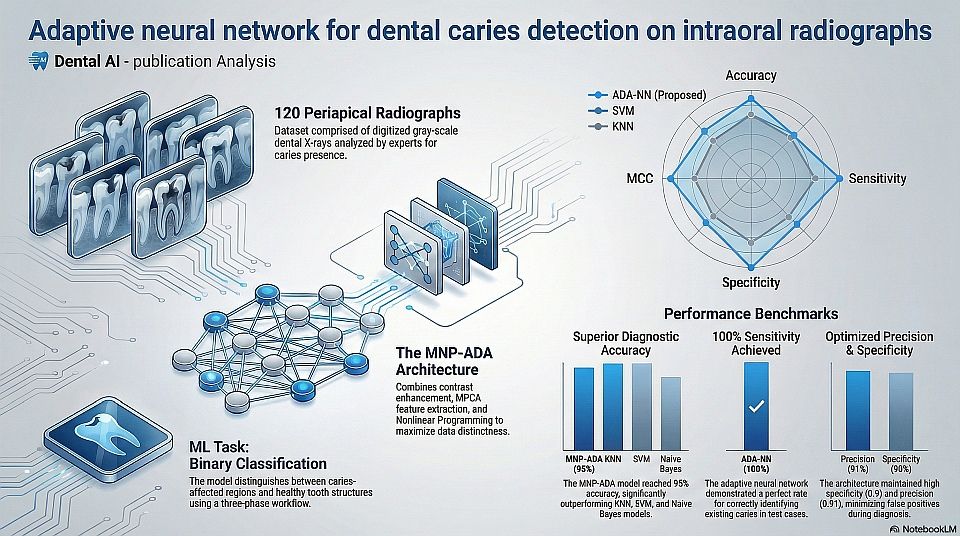
The study presents an automated caries detection model designed to accurately identify tooth cavities through image processing and machine learning. The methodology involves two primary phases: feature extraction using Multilinear Principal Component Analysis (MPCA) and classification using a Neural Network (NN). To improve performance, the features are optimized via Nonlinear Programming, and the NN is trained using an Adaptive Dragonfly Algorithm (ADA). Experimental results on a database of 120 X-ray images demonstrated that the proposed model (MNP-ADA) significantly outperforms conventional classifiers in metrics such as accuracy, sensitivity, and specificity
4. Key Words: Dental caries; Artificial intelligence; Neural networks; Intraoral radiography
VISUAL SUMMARY
5. Extracted data
5.1. Year: 2019
5.2. Modality: Periapical
5.3. Dataset: 120
5.4. Dataset Split: 75% for training and 25% for testing
5.5. Network Architecture: Feed-forward Neural Network
5.6. Metrics: accuracy, sensitivity, specificity, and precision, FPR, FNR, NPV, FDR, F1Score and MCC.
5.7. AP - Professional Qty: Not specified
5.8. AP - Supervisor Presence: Not specified
5.9. AP - Experience Level: Not specified
5.10. AP - Expertise Area: General dentists
5.11. AP - Tool or System: Not specified
5.12. ML Task: Classification
5.13. Project Objective: Automated detection of dental caries
6. Clinical Relevance: Early detection of dental caries is vital because tooth decay occurs in hard tissue and, if left untreated, can progress to pulp tissue inflammation, requiring complex and expensive treatments. While large caries can be seen by the naked eye, incipient lesions and "hidden caries" are difficult to identify and often invisible on the surface. Radiographic examination is essential for evaluating posterior teeth, and the proposed algorithmic model provides a novel, high-performance tool for distinguishing these dental caries more accurately than traditional manual or visual inspection methods.