
Blog
Classifying Temporomandibular Disorder with Artificial Intelligent Architecture Using Magnetic Resonance Imaging
Zih-Kai Kao; Neng-Tai Chiu; Hung-Ta Hondar Wu; Wan-Chen Chang; Ding-Han Wang; Yen-Ying Kung; Pei-Chi Tu; Wen-Liang Lo; Yu-Te Wu
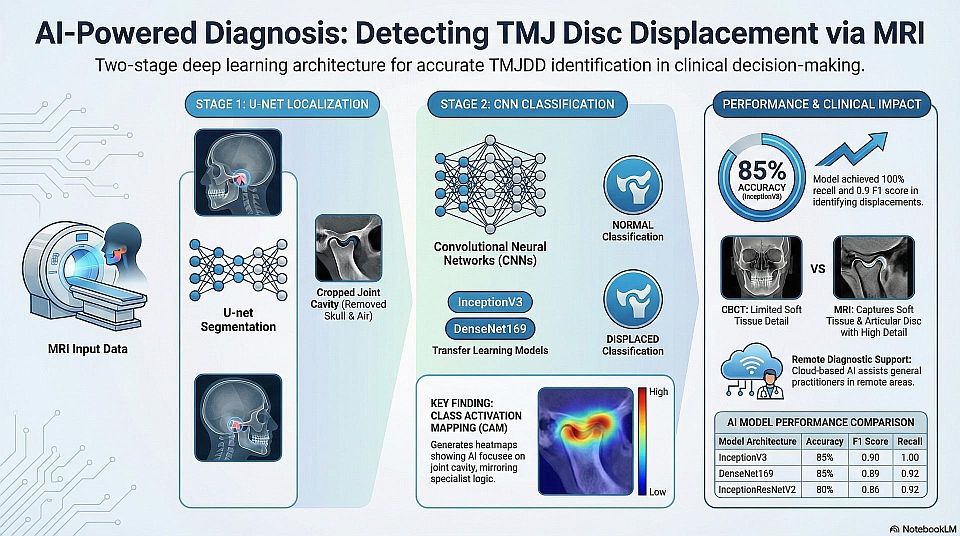
This study proposes an AI-assisted diagnostic system for the automatic detection of temporomandibular joint disc displacement (TMJDD) using sagittal MRI images. A two-stage deep learning pipeline was developed, consisting of U-Net–based segmentation to localize the joint cavity followed by CNN-based classification. Transfer learning with InceptionResNetV2, InceptionV3, DenseNet169, and VGG16 was evaluated. InceptionV3 and DenseNet169 achieved the best performance, demonstrating that deep learning applied to MRI can support clinicians in TMD diagnosis.
Temporomandibular disorder; Magnetic resonance imaging; Deep learning; U-Net; Convolutional neural network; Transfer learning
The automated detection of TMJDD using deep learning provides a promising support tool for clinicians, especially given that traditional physical examinations can sometimes be ambiguous. Early treatment facilitated by such AI systems is a key factor in improving patient outcomes and preventing chronic pain or disability. Furthermore, the system could be implemented via cloud-based remote access, allowing general practitioners in remote areas to receive diagnostic assistance from trained models on their mobile devices