ANN-based classification of tooth features using 3D dental scan data
1. Title:
Artificial Neural Networks as a powerful numerical tool to classify specific features of a tooth based on 3D scan data
2. Authors:
Andrea Rizzoli; Daniele Chiesi; Andrea Nocerino; Matteo Raspanti; Marco Gherlone
3. Summary:
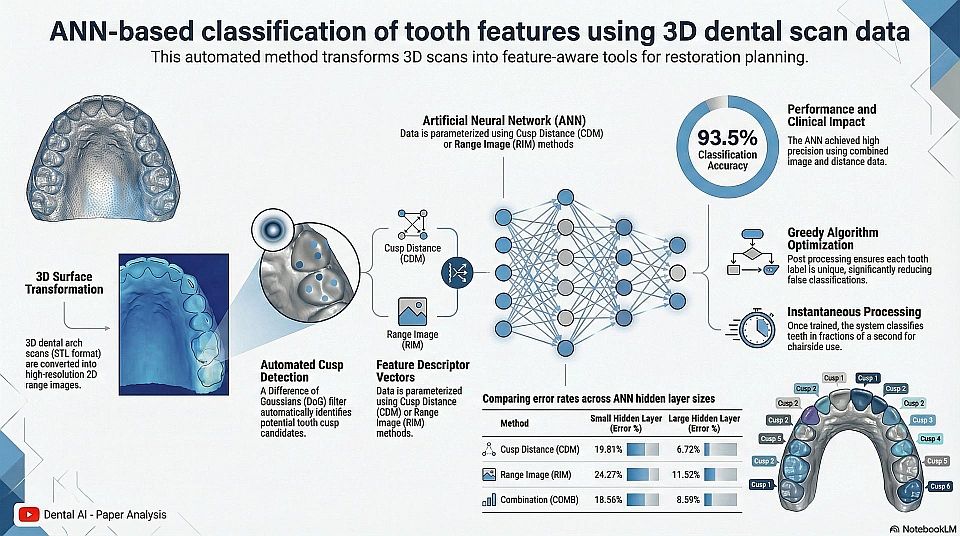
This study presents an automated method for the classification of teeth using Artificial Neural Networks (ANNs) based on 3D surface scan data of dental arches,. The authors processed 129 digital plaster casts by transforming them into range images and using an automated algorithm to detect cusp candidates, which were then manually labeled for training,. Three feature extraction approaches were tested: a Cusp Distance Method (CDM), a Range Image Method (RIM), and a combination of both (COMB). The study found that the CDM approach with a large hidden layer achieved the best performance with a correct classification rate of approximately 93%, demonstrating the potential for this technology to improve automated digital workflows in prosthetic dentistry
VISUAL SUMMARY
4. Key Words: Artificial neural networks; 3D scan; Tooth morphology; Classification
**5. Extracted data
5.1. Year: 2016
5.2. Modality: 3D dental surface scans
5.3. Dataset: 129 datasets
5.4. Dataset Split: The data was split into cross-validation sets, where each test set contained five mandibles, resulting in 12 or 13 sets depending on the jaw type
5.5. Network Architecture: Artificial Neural Network
5.6. Metrics: Rate of Error
5.7. AP - Professional Qty: Not specified
5.8. AP - Supervisor Presence: Not specified
5.9. AP - Experience Level: Not specified
5.10. AP - Expertise Area: Not specified
5.11. AP - Tool or System: Blender**
5.12. ML Task: Classification**
5.13. Project Objective: To develop an Artificial Neural Network capable of classifying dental cusps with sufficient accuracy
6. Clinical Relevance: This technology is a prerequisite for a fully automated digital process chain in dentistry, moving from 3D surface scanning to automated chairside manufacturing of prosthetics,. By eliminating the need for manual interaction by a human operator, the system reduces user dependence, saves time, and provides objective, evidence-based analysis of prosthetic results,,. Furthermore, the classification is performed in fractions of a second, allowing for instantaneous integration into clinical treatment routines